
Vauvert Primary School

Medical & Health Information
Medication
Vauvert Primary School will administer medication only when they are in receipt of a medical form. The form is available from the school office.
All medication must be brought to the school office by an adult, who will be asked to complete an “Administration of Medication” Form, giving full instructions of dosage needed etc.
Please note that:
- Medicines that need to be taken three times a day could be taken in the morning, after school hours and at bedtime.
- The school will not accept medication that has been taken out of the container as originally dispensed and will not make changes to the prescribed dosage on parental instruction.
- The medication must be collected at the end of the school day by the parent/carer.
- There is no legal or contractual duty on child-care settings or school staff to administer medicine or supervise a child taking it. This is a voluntary role.
- Medical equipment such as asthma inhalers and EpiPens are retained in school. Parents must ensure they are in date.
Illness
In the event of your child being unable to attend school because they are unwell, please contact the school office on 01481 220419 (24 hour answering machine service), or via Dojo or email. If they need to remain off school for longer than two days. You will need to let the office staff know. All absences will be recorded as unauthorised until we have been informed of the reason for the absence.
Some illnesses require a set period away from school. Please contact your GP, school nurse or the school office to discuss. If your child has suffered from vomiting and/or diarrhoea, they should not return to school until 48 hours after their last bout of illness. We will adhere to all current Public Health requirements regarding illness.
We monitor all children’s absences and liaise closely with the Schools’ Attendance Service. If your child has regular absences due to illness you may be asked to supply medical information from a doctor or other health practitioner.
If your child is ill during the school day, we will contact you to discuss the problem, and then, depending upon the outcome, request that you collect your child from school.
The school follows the Health Protection Agency guidance on preventing infection. Please click on the following links for further information and guidance.
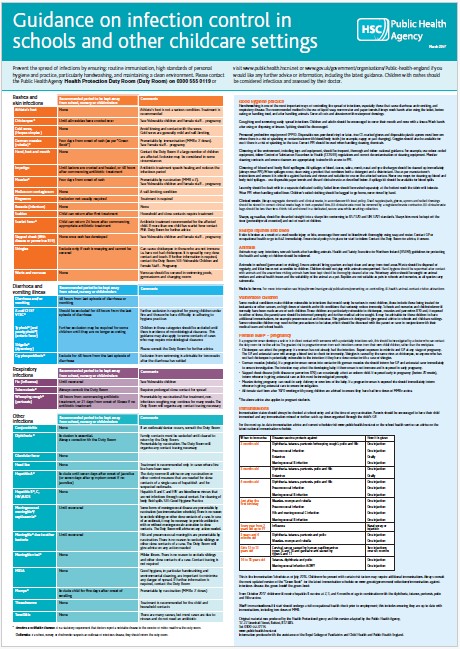
Guidance on infection control in schools and other childcare settings
Is my child too ill for school?
Medical and Dental Appointments
We would encourage you to make any necessary appointments outside of the school day. However, we accept that this is not always possible. Please let the school know who will be collecting your child prior to the appointment and children should return to school as soon as possible afterwards.
Injuries at School
There are qualified First Aiders in school at all times who are able to take care of any children who have an accident while at school. The First Aiders qualifications are renewed regularly.
Any minor bumps and scrapes sustained by children are treated by school staff. Children who receive First Aid treatment for a head injury will receive a red slip with head injury instructions. We will also send a Dojo home with this information. All injuries and treatment are logged in the accident book. If a child receives a serious injury we will contact you via telephone. Should we be unable to contact you, we will act on your behalf and contact the doctor or, in an emergency, take the child to the Accident and Emergency Department at the PEH. It may be necessary in some cases to call for an ambulance to take the child to hospital. These will be billed directly to you. Clearly, it is vital that we have up-to-date contact details as well as any information about any health issues or known allergies.
Food Allergies
Some pupils and members of staff at Vauvert Primary School suffer from food allergies, e.g. nut allergies. Therefore, Vauvert Primary School is a nut free school. These can be potentially very serious, leading to anaphylactic shock, which is life threatening. Other pupils may have special dietary needs because of a medical condition. The child’s parent or those with parental responsibility have the responsibility of informing school staff of any food allergies or special dietary needs when they register their child, or as soon as it becomes known.
Requests will only be passed on if a letter or other documentary evidence from a doctor or dietician supports them. A risk assessment is undertaken for each child at risk, and measures put in place to minimise the risk as much as possible. Key staff are trained to administer any required treatments e.g. an epipen.
The School Nursing Service can offer advice and information about diets, food allergies and implications for schools.
Head lice
Head lice are an ongoing problem in schools. It is vital that parents and carers check the children’s heads every week and, if evidence of lice is found, it should be treated immediately. We recommend “wet combing” as the method of checking whether live lice are present. If you find live lice then you need to treat with a head lice lotion that can be obtained from your local chemist. Parents and carers are responsible for obtaining the lotion themselves. The school nurses do not do routine head inspections. Head lice transfer quickly from head to head so if we find a child with head lice in school we will call parents and ask them to treat them before they return to school the next day.
The Prevention and Treatment of Headlice
School Nursing Service – Lukis House, The Grange, St. Peter Port. Tel. 220000
School nurses are registered nurses specialising in all aspects of child health and are employed by Health and Social Care. Their service is free and confidential. They work in close liaison with other professionals in the health service, and other agencies involved with the care of children and education. School nurses are an excellent source of useful information on health, contact numbers and advice. Both parents and teachers can access their services directly if they have concerns about a child’s health.
Every school on the island has a designated school nurse who visits regularly and carries out any routine health screening as well as hearing, vision or health checks requested by teachers or parents. School nurses are available, through Lukis House, every weekday during term time from 9.00am – 5.00pm.
Any health issue discussed is done so with complete confidentiality, however any issues or disclosures that raise concerns about any child’s safety or child protection matters will be passed on to the appropriate agencies. School nurses are also available for Health Promotion talks and assist teachers with various presentations in line with Education’s PSHE and Citizenship curriculum.